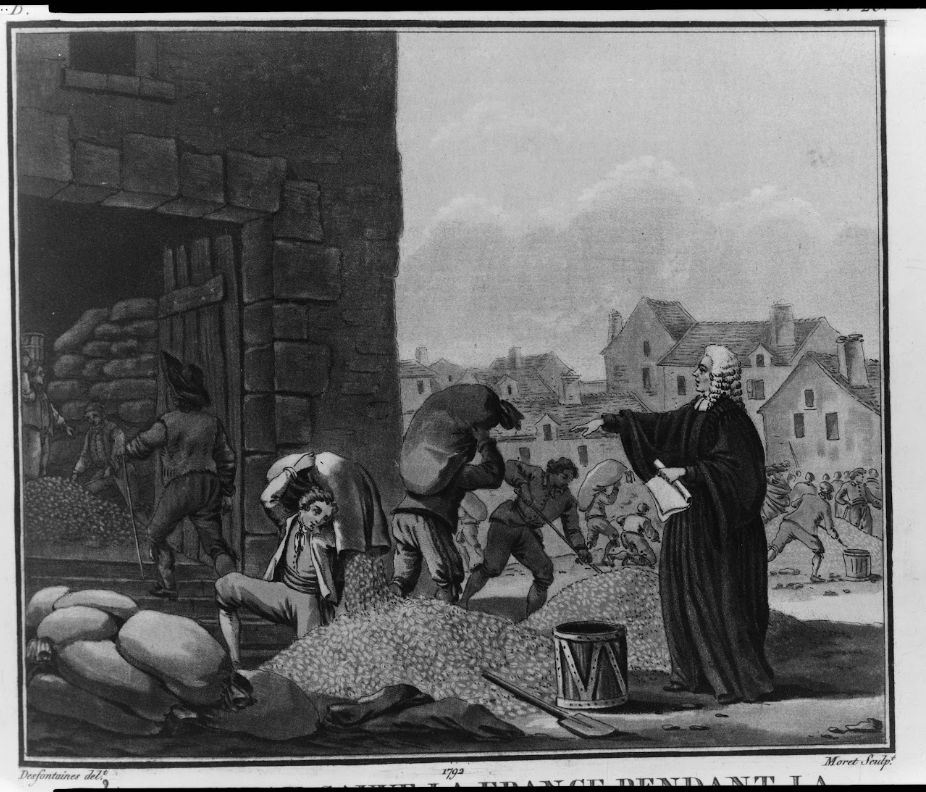
The Artifice of Natural Disasters: Famines
Report By Shawn Galligan, Sage Handin, Laurel Ives, Ethan Marple, and Ajan Vereen - Fall 2025
Famines are not caused by agricultural failure, but are often politically manufactured by wars, empires, and mankind. Hunger has continually been used as leverage in conflicts such as Ireland, Yemen, Sudan and Gaza. Under all of these circumstances, individuals have been starved out of their homes as their food is exported, withheld, or tampered with. Hunger is rarely due to natural causes, it is often constructed by individuals who hold power and are attempting to dominate specific groups of people. Instead of using ammunition, withholding food has become a violent weapon of geopolitics. By studying a variety of food systems and famines, we uncover below the system of infrastructure and violence that are tied to power dynamics and political manufacturing through hunger.
Artificial famine, specifically as a tool of empire and a method of oppressing vulnerable communities, can be observed throughout history. In the cultural imagination, there is a dominant ‘natural’ connotation applied to famine, despite the reality that many historical famines were artificially created or worsened by the influence of empire. In the 19th and 20th centuries, The British Empire orchestrated multiple artificial famines, including the Irish Great Hunger of1845-1852 and the Bengal famine of 1933-1944. While these two famines are not the only artificial famines in history, they serve to demonstrate both the impact that imperial intervention can have on creating and extending famine conditions, and the wide gap between cultural conception and the reality of famine. In his book Ireland Before and After the Famine, Irish historian Cormac Ó Gráda wrote that “Although the potato crop failed, the country was still producing and exporting more than enough grain crops to feed the population. But that was a 'money crop' and not a 'food crop' and could not be interfered with” (Ó Gráda). These ‘natural’ elements of famine, such as crop failure, can often overshadow key realities of famine in public discourse, such as the techniques deployed by empire to worsen famine. In her famous song, “Famine”, Sinead O’Connor declared “There was no famine … Meat, fish, vegetables / Were shipped out of the country under armed guard / To England while the Irish people starved” (O’Connor).
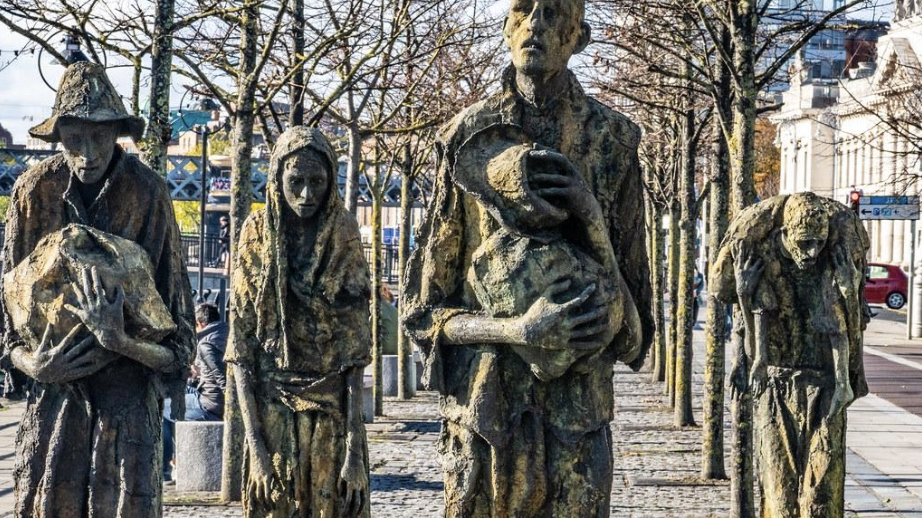
Irish Famine Memorial - Dublin
Irish Famine Memorials span the globe and are a testament to the radical transformation of both Irish and Irish immigrant communities around the world. For more information see here (Leads to an external site)
O’Connor and Ó Gráda both make clear that the Irish famine was dramatically worsened by an empire that could have alleviated it. A similar intervention of the British empire can be observed in Bengal, with the famine of 1933-1944. For the New Internationalist, anthropologist Jason Hickel observed that “the British blamed the famine on weather conditions and food shortfalls”, but that the famine was really due to intentional “war-time inflation … the impoverishment was no accident … imposed most harshly on the people of Bengal, who fell into extreme famine, while food supplies were appropriated and diverted for military use” (Hickel). Hickel further notes how the British dominant narrative of the Bengal famine, which blamed the famine on “weather conditions and food shortfalls”, ignores the “deliberate policy” of famine constructed by the British empire (Hickel). In the case of both the Irish and Bengali famines, the British Empire not only appropriated enormous amounts of food from a starving population, but used famine as a tool for military and imperial control.
Within the current international context, the persistence of politically manufactured hunger remains apparent in crises such as those in Yemen, Sudan, and Gaza. Examined in their entirety, these cases collectively debunk long-held assumptions about the format of famine and the process in which it “naturally” unfolds. They work to demonstrate that famine is not a direct or necessary product of scarcity, but the result of conflict, barricades, and the calculated distortion of food distribution. According to UN reports, Yemen endures one of the most critical humanitarian crises today, with over 16 million individuals food insecure (UN OCHA, 2023). The combination of ongoing civil war and coalition-imposed port closures has destabilized the food supply chain of a nation that cannot feed itself without it. It is not the desert that starves the people, but the siege that withholds their calories. Hunger functions as an instrument of power in this conflict, as it twists the access of food into an outcome of control.
The outbreak of violence in Sudan has left farming cycles astray and has forced millions of people from their communities. Evidence points to fields deliberately set ablaze, infrastructure systematically destroyed, and a targeted obstruction of humanitarian access. (WFP, 2024). Commonly regarded as the site of the world's first “climate war”, Sudan has endured and revealed the systematic effects of environmental duress, scarcity, and violence. These convergences find clear parallels in modern-day Gaza, where food and water are likewise weaponized. The nature of warfare has transformed their dinner table into a battlefield, where scarcity is pulled from the soil itself. It consumes the fields, collapses the structures, and starves a nation by destruction rather than denial.
Another factor to consider in relation to global hunger is our current global climate crisis. Due to agriculture itself contributing deeply to climate change, the more desperate famines become, the more of a negative impact agriculture has on the environment. This cyclical effect further contributes to the droughts and floods that disproportionately affect more vulnerable nations, especially since wealthier nations are better able to adapt to these adverse effects of climate change. For this reason, indigenous (communal and sustainable) food systems offer options that fight against profit-driven agriculture, but these small communities are often overshadowed and foiled by the wealthier and more powerful industries at play (Isapi Rua, “Indigenous Peoples’ Food Systems and Agroecology: Synergies and Convergences”).
In other words, similar to how these industries are the forces that choose which people will be most affected by famine, they also decide who will be the most impacted by climate change, thus the least able to fend for themselves, even with these indigenous food systems available. Narratives of famine are authored by those who control governments, politics, and people. Famine has been used as a tool throughout history to control and dominate the future of oppressed and marginalized groups. When farms, water sources, stores, and everything else has been destroyed or tainted with, growing or obtaining food is impossible. Climates and homelands have been replaced with rubble and dust-these conditions have been caused by war, conflict and politics. These intentional choices lead to the death and destruction of those individuals that they want to drive out. Examining these narrative structures from this lens allows for a perspective that acknowledges famine as intentional, not naturally occurring due to lack of food. In order to obtain justice and peace, hunger has to be recognized as a political weapon, not something that naturally occurs.
UNESCO examines the impact of climate change and war in Sudan
The ongoing blockade of Gaza has significantly aggravated its already compromised food system. Even before the latest strikes, reports by organizations like Human Rights Watch reveal that pre-existing measures such as fishing bans, curtailed agricultural imports, and repeated farmland demolition have ravaged the nation.(Human Rights Watch). Prior to the escalation of these measures against local production, the majority of Gaza's food supply entered through official border passages, along with a constrained flow of imports from Israel and Egypt. This dynamic is particularly precarious, given that such dependency is inherently subject to political tension and control. UN experts have since condemned the mass starvation that has swallowed the country since October 2023 as "man-made" and "used as a weapon of war"(OHCHR). This crisis is a tangible outcome of a historical pattern that assigns hunger as a consequence of security. As before, narrative serves to justify devastation.
Despite best efforts, language is never neutral. Phrasing and word choice can be wielded with considerable effect on the perceptions of the public. This curation of rhetoric has been employed since time immemorial to weave narratives with the intent to dull harsh truths and diminish justifiable ire whilst deflecting blame from themselves to the environment, which cannot speak to correct them. A most apt example of this kind of curated narrative is The Irish Potato Famine of 1845-1852, which saw the preventable deaths of an estimated one million Irish as well as the migration of thousands more than that. One can discern merely by the most well-recognized denomination of this catastrophe how the significant part which the British government played in this tragedy was intentionally downplayed. The designation “Irish Potato Famine” and much of the deliberately worded narratives surrounding it sought to cultivate the understanding of this atrocious occurrence as unavoidable to obscure the fact that the true reason for the Great Hunger was not a blight on potatoes, but that the British government had allottedonly a meager portion of Irish farmland to sustaining the local population whilst demanding all other bounties of the Earth and livestock be shipped to England’s markets, even as the Irish people starved. Such intentional misrepresentation is far from an uncommon phenomenon, as similar strategies can be perceived in the classification of Palestine as lifeless desert in order to justify colonization of the land and displacement of the people
Activists link militarism in Gaza and the climate crisis to systemic injustice
UMass Amherst student journalist's view on the war in Gaza and Climate Change - Our Climate's Battle Wounds (Leads to an external site)
Works Cited
Hickel, Jason. “How British Colonizers Caused the Bengal Famine.” New Internationalist, 21 January 2022
Human Rights Watch. Israel: Starvation Used as Weapon of War in Gaza. 18 Dec. 2023,
O’Connor, Sinéad. “Famine.” Universal Mother, Ensign, 1994.
Ó Gráda, Connor. Ireland Before and After the Famine: Explorations in Economic History, 1800-1925. Manchester University Press, 1993.
Office of the High Commissioner for Human Rights (OHCHR). Gaza: Starvation Being Used as a Weapon of War — UN Experts. United Nations, 16 Nov. 2023,
Office of the High Commissioner for Human Rights (OHCHR). Using Starvation as a Weapon of War in Sudan Must Stop: UN Experts. United Nations, 6 June 2024,
Rua, Isapi. "Indigenous Peoples’ Food Systems and Agroecology: Synergies and Convergences.” Cultural Survival, 16 January 2024,
United Nations Office for the Coordination of Humanitarian Affairs (UN OCHA). Yemen Humanitarian Needs Overview 2023. ReliefWeb, Dec. 2022.
World Food Programme (WFP). Sudan Emergency. WFP, 2024,