Exploring the Archive: Minerals
Lyla Barnett
The Rausch Mineral Gallery, while intriguing and deeply enrapturing due to its vast collection of glittering ores, is not, on the surface, somewhere one would go to consider the relationship humanity shares with nature. However, when one thinks more deeply about those ores, the connection is unmistakable. The gallery contains a sample of quartz; its crystalline structure is in a tectosilicate formation, and its chemical compound is SiO2. Quartz is a key component of electronic technology’s timing and precision, since its properties connect to technological sensing and measurement systems. While this connection is relevant to today’s society, the correspondence between Earth’s minerals and humanity goes much deeper in some cultures. Looking at quartz this way also raises a larger question: have minerals always been treated as resources for extraction and control, or have other cultures understood and used them differently?
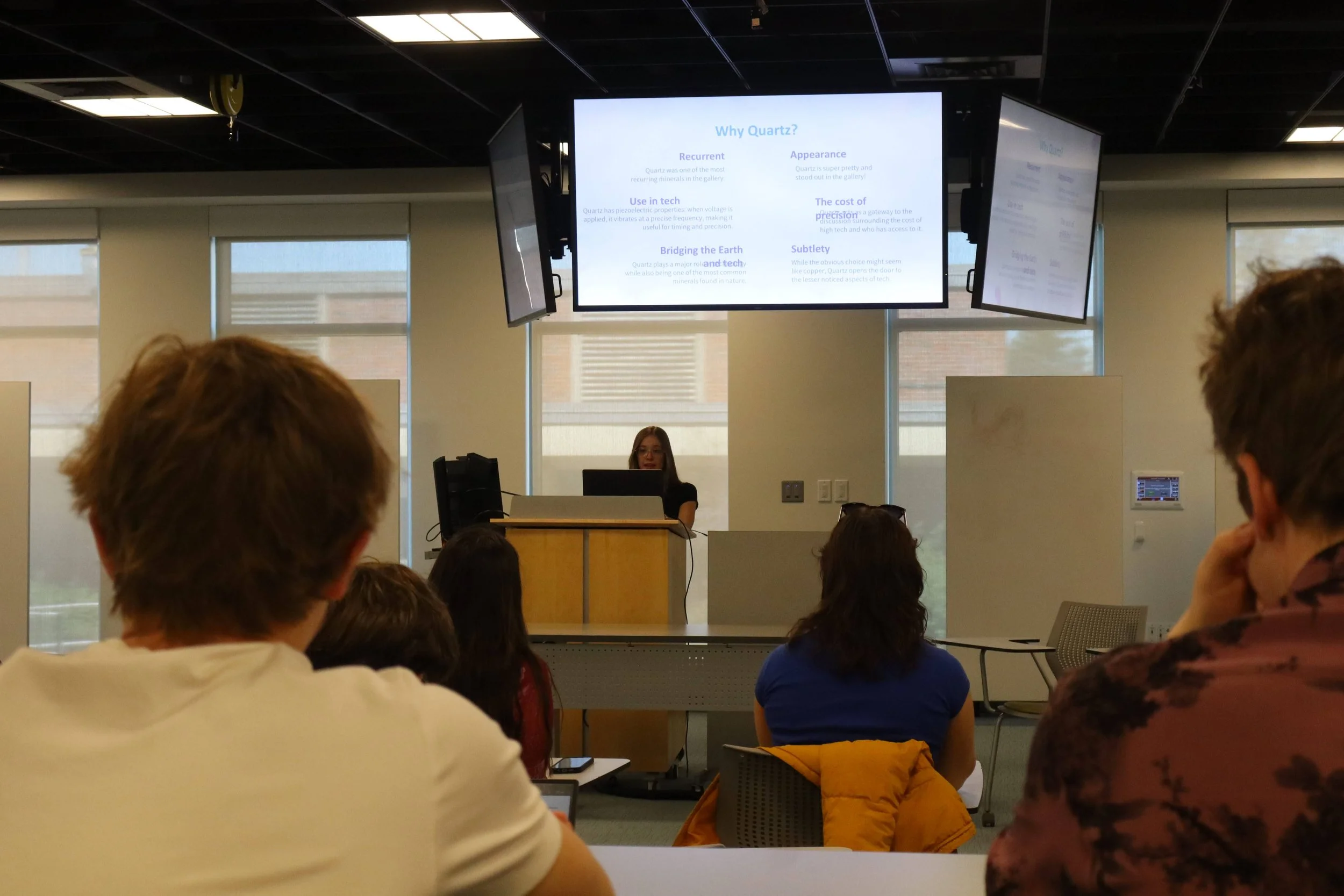
Lyla Barnett presenting her research on quartz from the Rausch Mineral Gallery
This can be seen among native tribes across North America whose tongues come from the Algonquian language family. Quartz, as one of the most common minerals on the planet, was widely used by an assortment of American Indian groups across the Great Lakes region. The employment of quartz by Algonquian-speaking tribes ranges from practical to spiritual uses. In Northeastern Ontario, research on the Shield Archaic Tradition, which archaeologist James Wright originally defines as “...a widespread stone tool complex characterized by biface and uniface blades, lanceolate and sidenotched projectile points, and a wide range of scraper varieties, crude chopping and scraping-cutting tools and a paucity or absence of stone grinding” reveals multiple sites where those artifacts have been found, some of which are made of quartz (7). These sites exemplify the practical uses for quartz that Algonquian-speaking tribes had. However, in Central and Eastern Canada, those tribes also used quartz in aspects of what is known as rock art, which Memorial University of Newfoundland’s archaeology professor Bryn Tapper defines as “mainly compris[ing] pictographs and petroglyphs painted, pecked, abraded, and incised on the exposed cliffs and rock outcrops found along the shore of rivers and lakes” (725). Algonquian oral traditions indicate that Rock Art was grounded in spiritual beliefs such as shamanism and can be used to contextualize the art within its physical environment (Tapper 726). A common belief held by Algonquian tribes credits the making of Rock Art to ‘little people’, ‘fairies’, ‘rock medicine men’, ‘thunderbirds’, or ‘horned serpents’ who were believed to live in rocks along shorelines (Tapper 730). These mythical creatures were thought to connect the spiritual realms and the physical world (Tapper 730).
Quartz and other minerals were used very differently in the past by indigenous communities than they are in modern society. My goal is to explore the differences between how minerals, with a focus on quartz, were obtained and used by indigenous populations in the past versus how humanity obtains and uses minerals today. Ultimately, quartz paves the way for a larger story. What appears as a simple mineral specimen in the Rausch Mineral Gallery opens questions about history, culture, extraction, and technology. While Indigenous communities connected to quartz on a practical and spiritual level, in the modern world, it has become part of the hidden material foundation of digital systems. Simultaneously, quartz is part of a wider mineral receipt behind computers and artificial intelligence, where many materials are mined, processed, and assembled to make technology feel instant and immaterial. Beginning this work will show that the digital world is not separate from Earth but deeply rooted in it. Even systems we think of as invisible are built from land, labor, and resources that often remain out of sight.
Works Cited
Pollock, John W. “ALGONQUIAN CULTURE DEVELOPMENT and ARCHAEOLOGICAL
SEQUENCES in NORTHEASTERN ONTARIO.” Bulletin (Canadian Archaeological
Association), no. 7, 1975, pp. 1–53. JSTOR, www.jstor.org/stable/41242396,
https://doi.org/10.2307/41242396.
Tapper, Bryn. “Exploring Relationality: Perspectives on the Research Narratives of the Rock Art
of the AlgonquianSpeaking Peoples of Central and Eastern Canada.” Journal of
Archaeological Method and Theory, vol. 27, no. 3, 2020, pp. 723–744. JSTOR,
www.jstor.org/stable/45380844, https://doi.org/10.2307/45380844.
