Exploring the Archive: Oral History
Kai Martens-Wallace
The Audrey R. Duckert Quabbin Valley Oral Historical Collection is a series of 53 audiocassettes. The tapes detail the flooding of the towns of Dana, Enfield, Greenwich, and Prescott in Western Massachusetts in order to create the Quabbin Reservoir. The Quabbin Reservoir is the primary water supply for Boston and the greater Boston area, and was created to address a growing water demand in the area. The reservoir supplies water for nearly 3 million people in Massachusetts.
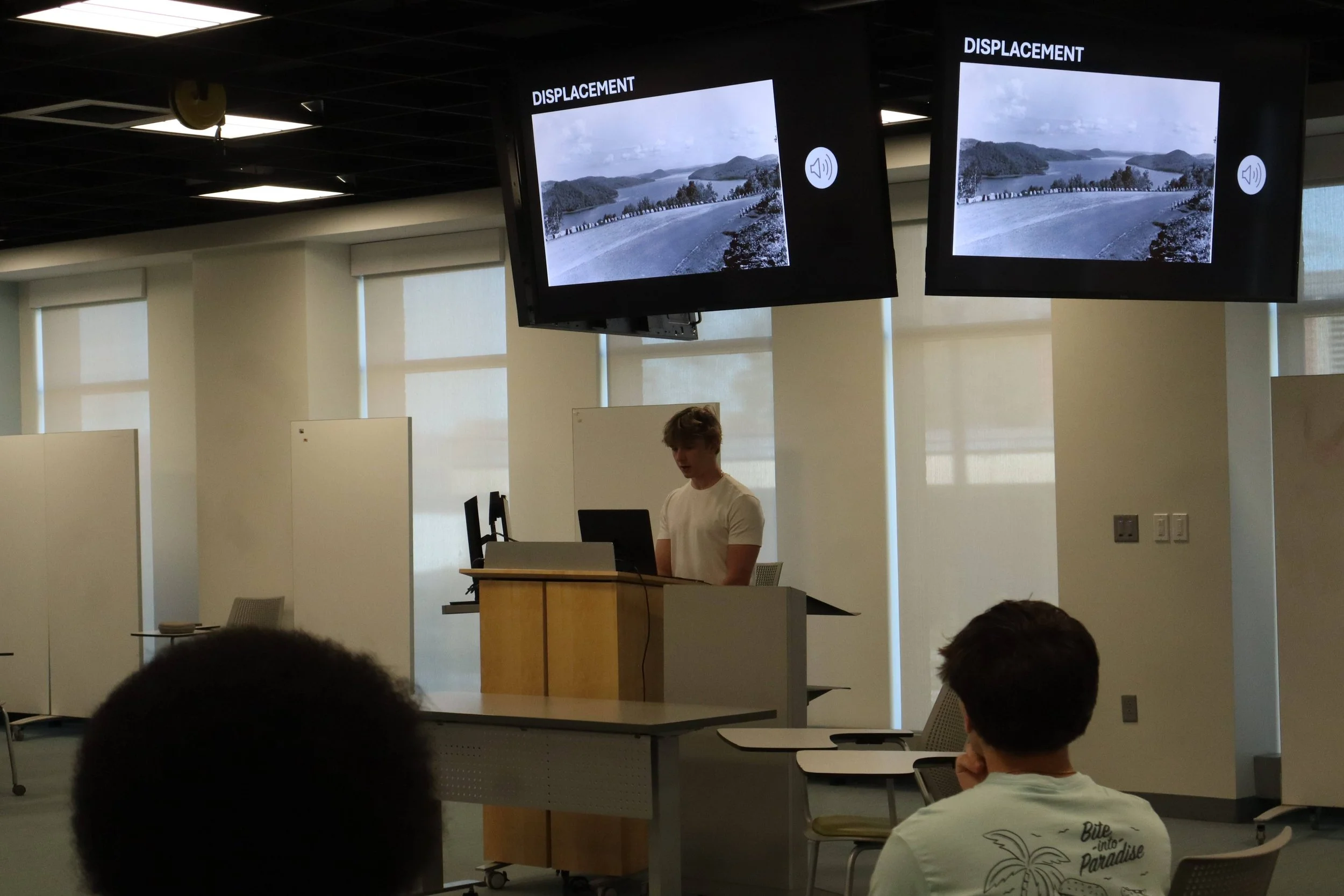
Kai Martens-Wallace presenting research on oral history
The tapes consist of formal interviews, audio recordings of public presentations, genealogical programs done by the Swift River Valley Historical Society, and radio broadcasts. Approximately 2,500 people were displaced by the flooding of the Swift River Valley, and the collection attempts to consolidate the recollection of those who were. In 1927, the residents of the valley were given a deadline of April 27, 1938, to relocate elsewhere, with compensation of $108 per acre lost.
Audrey Duckert’s collection of tapes is a beautiful preservation of history that may have been otherwise lost. Oral tradition and the passing down of knowledge through language from one generation to the next are the original methods we as humans used to retain knowledge and memories of the past. However, where oral tradition often suffers is in the preservation of it over extended periods of time, especially in today’s modern era, where so much knowledge is stored in text, video, and other forms of long-lasting, permanent content. Like the game of telephone so many of us remember from our childhoods, the idea at the beginning of the chain is often distorted or completely lost by the time the line reaches its end. However, the beauty of Duckert’s collection is that it preserves oral tradition in that permanent, and undistortable format. And secondly, the audio and words of the people preserved on these tapes are those who lived through the flooding, who lived in these towns before the flooding, and who have memories of growing up and living in these places lost to time. They aren’t the words of a secondary source, but those who have firsthand experience of this event in history, and what came before.
In my own research, I want to investigate the connection between the Swift River Valley flooding and the impending fog that is climate change. Like any good fog, climate change is ever-drifting and ever-murky. And as it approaches, what lies within the fog comes into view. And one of the most notable markers of climate change is water. When we think about climate change, we first think of rising temperatures and rising waters. And while the flooding of the Swift River Valley may seem unrelated to climate change, the opposite is actually true. The cause for the water shortage that drove the creation of the Quabbin Reservoir was in fact, because of rapid urbanization and pollution of local water sources. I aim to investigate the idea that climate change may permeate more of our lives than we might think, and already be upon us in ways we don’t see. If it affected the water supply of Massachusetts in the early 20th century, it certainly is affecting us today.
