Reflecting on Art(e)facts: Quartz
Lyla Barnett
For my research, I worked with the Rausch Mineral Gallery, an on-campus collection of minerals from all around the world located in the Morrill Science Center. While the gallery is filled to the brim with minerals, I chose to focus on quartz for its tech-friendly properties and its frequency in nature. Quartz opened the door to many questions surrounding the hidden factors of artificial intelligence. Artificial intelligence technology is becoming extremely prevalent in the modern world. Before this research project, I had never considered the physical structures that allow artificial intelligence to function at the level of performance that we have grown to expect. For example, the piezoelectric property of quartz enables artificial intelligence to operate extremely fast, so that when a person asks a chatbot a question, the answer is nearly instantaneous. Realizing this broadened the scope of my research to include a larger mineral receipt that began with quartz but incorporated a wealth of other materials. I found that artificial intelligence is only functional because of a wide array of different minerals and rare earth metals. One of the most shocking things I discovered through this research was how unethically minerals are obtained. In learning about dredging and open-pit mining, my eyes were opened to the production of waste that accompanies extracting these minerals, which are incredibly common. Dredging and open-pit mining use large equipment to efficiently excavate large quantities of earth at once. This debris is then sorted through, and any specimens of the desired mineral are removed. These mining techniques typically only yield ~1% of the desired mineral, in this case quartz, per extraction. The rest of the material excavated is reused for other purposes, but more often it is simply discarded. The contrast between modern excavation methods and how indigenous cultures gained access to quartz was one of the most surprising things to me. Algonquian tribes only used quartz that they found organically. There was no digging, no sorting, and no waste. In fact, the Earth and quartz were intrinsically valued within Algonquian culture. They believed that quartz linked the physical and spiritual worlds and often used quartz to record human interaction with the Earth through pictographs and petroglyphs carved or otherwise embedded into the mineral.
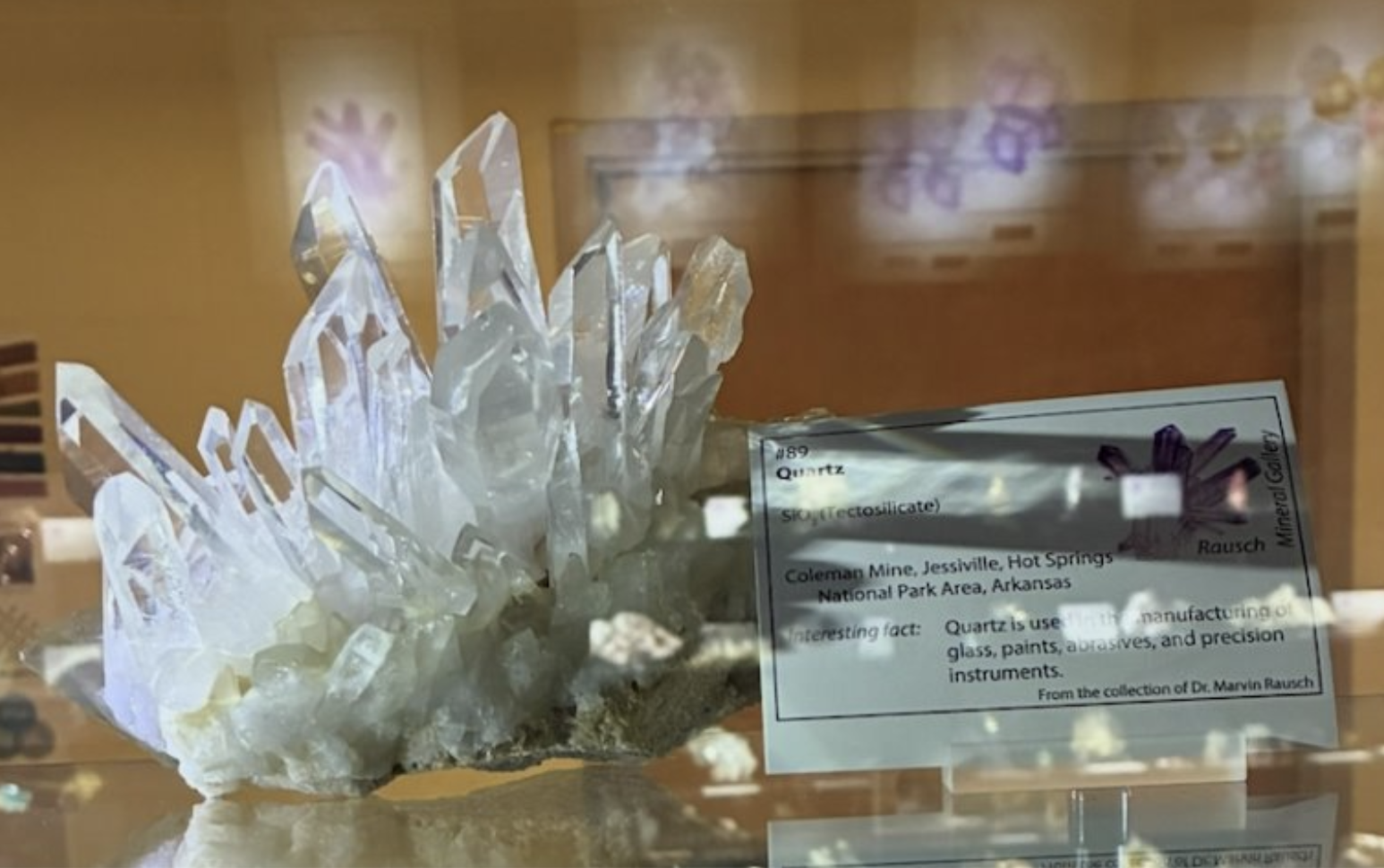
Quartz in the Rausch Mineral Gallery from the collection of Dr. Marvin Rausch
However, the physical procurement and use of minerals is only half of the story. Since different minerals are naturally more abundant in different parts of the world, certain world powers can often exclusively control certain minerals. An example of this is copper. The majority of the world’s copper reserves are located in China. Because the copper is in China’s territory, China controls its excavation, the supply chain, the selling rate, and therefore the entire copper market. The power that China exerts over the rare earth metals market globally cannot be understated. Extraction operations in the Democratic Republic of the Congo (DRC) and other African states focus on the harvesting of minerals such as gold, cobalt, silver, cadmium, and lead, which are key components of the growing electronic industry alongside quartz. This is incredibly important, as if a small selection of governments hold monopolies on certain metals and minerals, then they can dictate price level and market supply. In addition to countries restricting the availability of minerals, the supply chain promoted by these governments supports a corporate framework that promotes a large-scale infrastructure, including data centers, shipping, and commercial logistics, to create and consequently satisfy consumer demand. Data centers over the last half-decade have contributed to over one percent of global electricity usage annually. This, along with global shipping of mineral exports, drastically increases global carbon emissions.
To connect back to my previous point on Indigenous land use, both modern mining techniques and the political power exerted over the land place the burden on indigenous peoples. Colonialism is built on a foundation of research extraction. Practices similar to those of the Algonquian people rely on the respect of nature and its diverse components. Another example of this is illegal forestry practices in Brazil and Central America. Despite the efforts of indigenous groups there to protect natural environments, the state has stood by idly and allowed multinational corporations to violate those sacred spaces. Indigenous groups like the Algonquian people shoulder the overwhelming oppression that comes with their land being stolen and abused. What amazes me is that all of these political and humanitarian issues surface solely from looking at a piece of quartz.
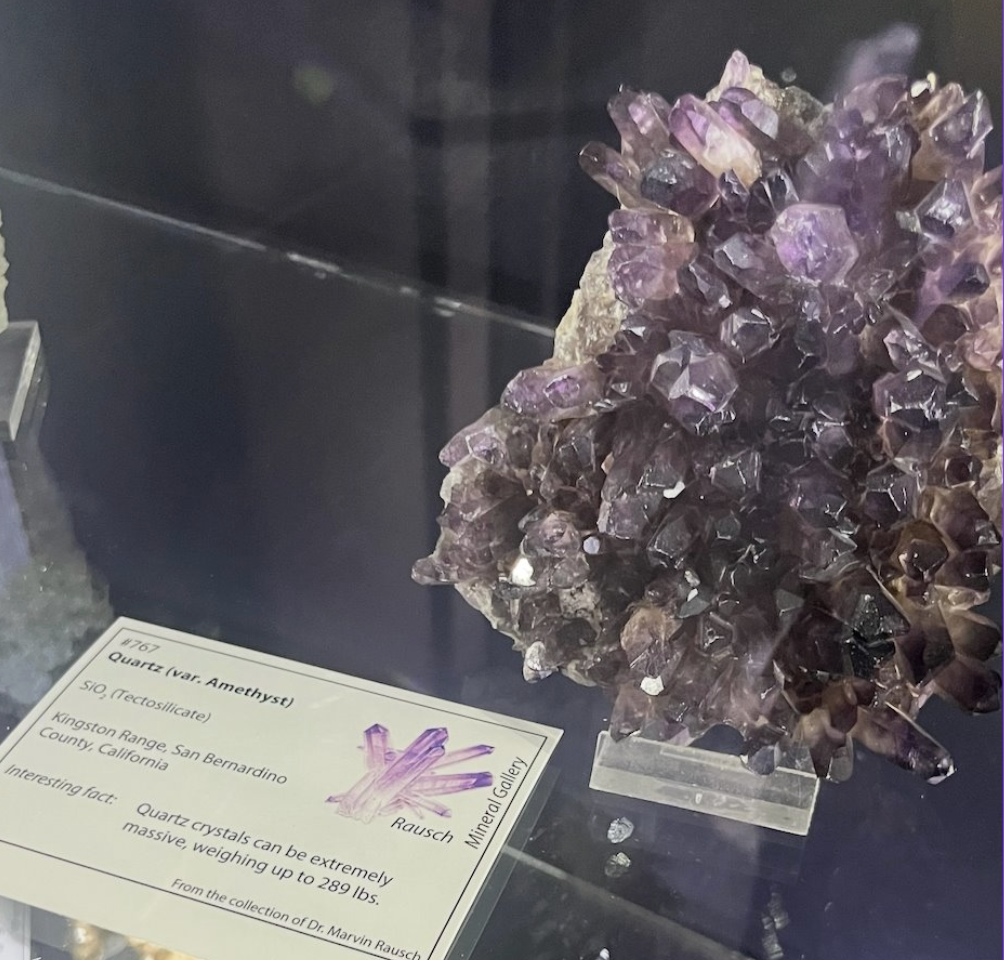
Amethyst Quartz in the Rausch Mineral Gallery from the collection of Dr. Marvin Rausch
Finally, the creation of artificial intelligence technology, and all technology in general, leads to the creation of e-waste. Before this research project, I had no idea what e-waste was, let alone how detrimental it was to the environment. E-waste will be here long after humanity will, and few people know what it is or how it is made. I believe that the future of this project lies in the exploration of more sustainable mining technologies. It is imperative that we explore possibilities to reduce e-waste and ethically mine natural resources. I would love to see the continuation of this research project in sustainability and policy. In terms of sustainability, I believe that it would majorly impact the earth’s overall health by reducing e-waste, and by criminalizing or banning dredging and open-pit mining, the overall trauma inflicted on the natural environment would be lessened. In terms of policy, I would love to see this research continued to promote the respect of the earth, especially in locations that have been sacred to Indigenous tribes in the past. I would like to see companies and governments take accountability for the harm they have caused, and for Indigenous peoples to be reimbursed for the crimes against them. I believe that this research would be extremely beneficial if brought to public attention, as if the general public knew how detrimental artificial intelligence chatbots are, then perhaps their use would be lessened. Grounding this technology in the earth was, for me, intensely eye-opening. It really made artificial intelligence technology seem less like a magically fast gift and more like a real, harmful thing. I believe that if more people were aware of the physical grounding of artificial intelligence technology, then more could be done to improve its effect on our earth.
